 Skip to content

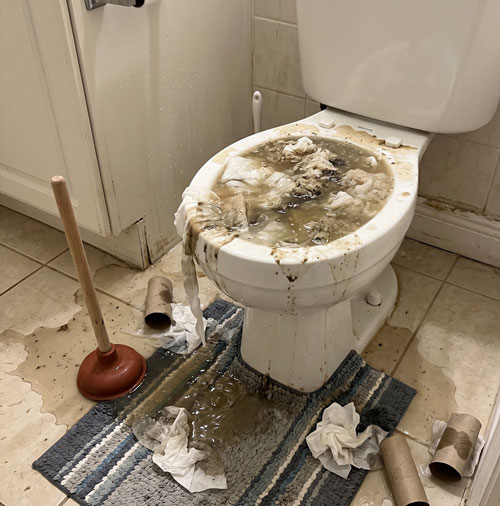
A toilet is one of the few things in a house that you can often diagnose yourself in about five minutes, and one of the few where a small unrepaired fault quietly costs real money every day. This guide covers how the mechanism works, what each symptom points to, and how to judge whether to repair or replace.
How the Mechanism Actually Works
Understanding four components explains nearly every fault. Lift the tank lid and you can see three of them.
The fill valve admits water after a flush and shuts off at the set level. The flapper is the rubber seal at the bottom of the tank; the handle lifts it, water rushes out, and it drops back to seal. The flush valve is the opening it seals against. Below, moulded into the china, is the trap — the S-bend holding standing water that blocks sewer gas from entering the room.
Note what a flush actually is. It is not the mechanism pushing waste through; it is the sudden weight of tank water creating a siphon in the trap. That is why a weak flush is usually a volume or airflow problem rather than a blockage, and why holding the handle down longer sometimes works.
The Running Toilet Is an Expensive Nuisance
A toilet that runs intermittently, or hisses, or refills for a few seconds without anyone touching it, is passing water continuously from tank to bowl and down the drain. It is doing so every hour of every day, and because the water leaves silently through the bowl there is nothing to see.
This is among the most common causes of an unexplained water bill. Flappers are the usual culprit — rubber hardens and distorts with age and water chemistry until it no longer seals. Alternatively the fill valve fails to shut off fully, or the level is set so high that water spills into the overflow tube continuously.
The good news is that these are inexpensive parts and among the more approachable repairs in a house. Guidance on household water efficiency is available through the EPA WaterSense program.
The Dye Test Settles It in Ten Minutes
If you suspect a silent leak but cannot confirm it, this is definitive and costs nothing.
- Take the tank lid off and add a few drops of food colouring to the tank water.
- Do not flush. Leave it undisturbed for about ten to fifteen minutes.
- Look in the bowl. Colour in the bowl means water is passing the flapper.
- Flush afterwards so the dye does not sit and stain.
A clean bowl rules out the flapper and points you at the fill valve or the water level instead. Worth running on every toilet in the house — the leaking one is often not the one you suspected.
Weak Flush Is Not the Same as Blocked
These get conflated and they have different causes. A genuinely blocked toilet rises and drains slowly or not at all. A weak flush empties, just poorly, leaving material behind or requiring a second flush.
Weak flushing usually traces to insufficient water volume — a tank level set too low, or a flapper closing too early because its chain is snagged or the float has been adjusted down. It can also be the rim jets: the small holes under the bowl rim that direct water round the bowl. In hard-water areas those scale up over the years, and a partially blocked set of jets reduces flush performance markedly. They can be cleared, and the improvement is often striking.
A blockage, by contrast, is downstream and needs a flange plunger or an auger. If several fixtures are affected rather than the toilet alone, the problem is the line, not the toilet.
Water on the Floor: Four Sources, Four Meanings
Where the water is tells you what has failed, so look before you mop.
At the supply connection — the fitting or the flexible line itself. Usually straightforward, and worth attending to promptly because supply failures can become substantial.
Between tank and bowl — the gasket and bolts joining the two, which appears only during and just after a flush.
From around the base — the serious one, covered below.
Everywhere, in humid weather, with no leak — condensation on cold china in a warm bathroom. Harmless in itself, though persistent condensation dripping onto flooring causes its own damage over time.
Why a Rocking Toilet Should Not Be Ignored
The toilet seals to the drain flange through a wax ring, compressed when the toilet is bolted down. It is a seal, not an adhesive, and it depends on the fixture staying still.
A toilet that rocks even slightly works that seal loose a little more each time somebody sits down. Once it is compromised, water and waste escape at the base on every flush — often beneath the flooring where nothing is visible until the subfloor has been wet for months. That is how a five-pound part turns into a floor repair.
If yours moves, address it. Sometimes it is loose closet bolts; sometimes the flange sits too low or has corroded and needs proper repair. Shimming a rocking toilet without resolving why it rocks treats the symptom only.
Repair or Replace
Internal parts are inexpensive and readily available, so repair is usually the sensible answer. Flappers, fill valves, supply lines, and wax rings are all routine.
Replacement earns its place when the china itself is cracked — which is not repairable and can fail suddenly — or when the fixture is very old and consuming far more water per flush than a current one, or when you are repairing the same toilet repeatedly, or during a bathroom renovation where access is already open. A hairline crack in a tank is worth taking seriously; tanks hold several gallons and a failure empties all of it.
What Changed in Modern Toilets
Fixtures manufactured before the mid-1990s often used substantially more water per flush than current models. United States federal standards set a maximum of 1.6 gallons per flush for new residential toilets from 1994, and WaterSense-labelled models operate at 1.28 gallons or less while being tested for flush performance.
The early low-flow generation earned a poor reputation for needing two flushes, which defeated the purpose. Bowl and jet design have moved on considerably since then, and performance testing is precisely what the labelling addresses. If your reluctance to replace an old fixture is based on experience with a 1990s low-flow toilet, that impression is out of date. Fixture standards are maintained by bodies such as the IAPMO plumbing standards organisation.
Measure the Rough-In Before You Buy
This is the detail that sends people back to the shop. The rough-in is the distance from the finished wall behind the toilet to the centre of the closet bolts holding it down — the centre of the drain.
Twelve inches is the common dimension, but ten and fourteen inch rough-ins exist, particularly in older construction. Measure to the wall itself, not to the skirting board. While you are at it, check the available width between side walls or vanity, and whether the space suits a round or elongated bowl.
What Never to Flush
Wipes head this list regardless of any claim on the packet. They do not break down like toilet paper, and they are a leading cause of blockages in household lines and municipal systems alike. Treat every one of them as landfill.
Also: paper towels, cotton products, dental floss, cat litter of any description, and medicines. Anything fibrous knits together with everything else in the line and forms a mass that will not clear on its own.
Questions From Paradise Homeowners
My toilet refills briefly every few minutes. Nobody is using it.
That is phantom flushing, and it means water is leaking from tank to bowl until the level drops enough to trigger a refill. Almost always the flapper. Run the dye test to confirm.
Can I put a brick in the tank to save water?
Please do not. Bricks break down and shed grit into the mechanism. More importantly, reducing volume in a toilet designed around a specific volume tends to produce double flushing, which uses more water overall.
The bowl empties itself between uses. Is that a problem?
Yes, worth investigating. The standing water in the trap is what blocks sewer gas from the room. A bowl losing its seal points to a venting problem, a partial blockage siphoning the trap, or a crack. If you also notice odour, address it rather than topping the bowl up.
Getting It Right
Most toilet problems are small, cheap, and worth resolving quickly — the running flapper wasting water daily, the slight rock quietly destroying a wax seal. The ones that become expensive are almost always the ones that were visible for months first.
Hire The Hippo Ideal Services handles toilet repair and replacement across Paradise and the valley, and for door hardware and access work our related locksmith and door hardware services cover that trade. If a toilet is rocking, running, or leaking at the base, contact our team before the floor beneath it becomes part of the job.
