 Skip to content
Hydro jetting gets talked about as if it were just a stronger drain snake. It is not. It is a different tool solving a different problem, and knowing which one your line actually needs is most of the battle. If you own a home in North Las Vegas, this guide explains what jetting does, when it helps, and — just as importantly — when it is the wrong call.
What Hydro Jetting Actually Does
A jetter pushes water through a hose to a specialised nozzle, typically somewhere between 1,500 and 4,000 psi depending on the line. Most of the jets face backwards. Those rear-facing jets do two jobs at once: they drag the hose up the pipe under its own thrust, and they scour the pipe wall on the way back out. The result is a line cleaned to its full inside diameter rather than merely perforated.
Because it is water doing the work, no solvents or caustic chemicals enter the drain. That matters for septic components, for older pipe materials that chemicals attack, and for anyone who would rather not keep a jug of drain acid under the sink. Water efficiency is worth a thought too — the EPA WaterSense program is a reasonable starting point if you are auditing household water use more broadly.
Why Valley Lines Scale Up Faster Than Most
Southern Nevada draws the bulk of its municipal supply from the Colorado River by way of Lake Mead, and that water carries a high dissolved mineral load — mainly calcium and magnesium. Hard water is not a health problem, but it is a plumbing one. Every time water sits or evaporates in a line, a thin mineral film is left behind.
Layer after layer, that film becomes scale. Scale is rough where new pipe is smooth, so it grabs everything that floats past: soap curd, hair, food solids, grease. A four-inch line does not fail because something enormous went down it. It fails because its working diameter quietly dropped to two inches over several years and the next ordinary Sunday load was simply more than the remaining bore could carry.
Jetting or Cabling? The Honest Difference
A drain cable — a snake — is a rotating steel auger. It is excellent at one specific thing: boring through an obstruction to restore flow, fast. When a toilet is backing up at ten at night, that is exactly what you want.
But a cable leaves the pipe wall largely as it found it. Punch a hole through a grease plug and water runs again, and you feel like the problem is solved. The plug is still there, still narrowing the line, still catching debris. That is why cabled drains so often back up again within months. Jetting removes the accumulation rather than tunnelling through it.
The practical rule: cable to restore flow in an emergency, jet to actually clean the line. They are complements, not competitors, and a good outfit will tell you plainly which one your situation calls for.
The Camera Inspection That Should Come First
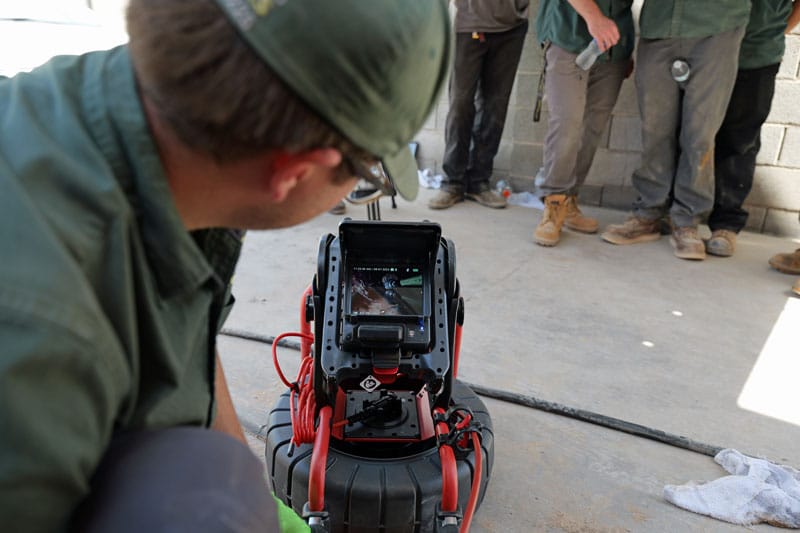
Jetting a line nobody has looked inside is guesswork with expensive consequences. A push camera answers the questions that determine whether jetting is safe and what it will accomplish:
- What is the pipe made of — ABS, PVC, cast iron, clay, or Orangeburg?
- Is the blockage grease, mineral scale, roots, or a foreign object?
- Are there offset joints, bellies, or sections holding standing water?
- Is the pipe structurally sound, or is it already cracked or collapsing?
That last question is the one that protects your wallet. Ask to see the footage — before and after. Any technician who will not show you the inside of your own pipe is asking for trust they have not earned.
When Jetting Is the Wrong Call
Jetting is not universally appropriate, and it is worth saying so out loud. High-pressure water inside a pipe that has already lost its structural integrity can turn a bad line into a failed one.
Deteriorated cast iron that has scaled and channelled from the inside, Orangeburg — a bituminised fibre pipe used in some mid-century construction that deforms as it ages — badly offset joints, and any line the camera shows as cracked or crushed all fall into this category. In those cases the honest answer is not a cleaning at all. It is a repair, a lining, or a replacement, and jetting first only spends money on the way there.
Grease, Scale, and Roots Are Three Different Problems
Lumping every blockage together is how lines get mistreated. Grease is soft and clings; it responds well to a jetter with a penetrating nozzle and hot-water-friendly technique. Mineral scale is hard and bonded to the wall; it needs a chain or rotary nozzle with genuine mechanical action, not just pressure.
Roots are their own category. A jetter fitted with a cutting head will clear roots effectively, but roots did not enter through solid pipe — they came in at a crack or a failed joint, following moisture. Cut them and they regrow to the same spot. Clearing roots buys time and restores flow; it does not repair the defect that admitted them. Anyone who tells you otherwise is selling you the same visit again next year.
Nozzles, Pressure, and Why Bigger Is Not Better
Pressure gets the marketing attention; flow rate does the work. Pressure breaks material loose, but gallons per minute is what carries the debris out of the line. A high-pressure, low-volume machine can dislodge a blockage and leave the pieces sitting in the pipe to reassemble downstream.
Nozzle choice matters just as much: a penetrating nozzle to open a path, a flusher to move solids, a chain or rotary head for scale, a cutter for roots. Matching machine and nozzle to the pipe is the skill involved. Fixture and fitting standards are maintained by bodies such as the IAPMO plumbing standards organisation, and a technician who can speak to why a given nozzle suits your line is showing you real competence.
How Often North Las Vegas Homes Actually Need It
There is no single correct interval, and any figure quoted without seeing your line is invented. What genuinely drives frequency is fixture count, pipe age and material, how much cooking grease reaches the drain, and whether mature trees sit near the lateral.
A newer home on ABS with no trees over the line may go many years without needing anything. An older property on cast iron with established landscaping is a different proposition entirely. Food-service kitchens are in another category again — grease volume there makes scheduled jetting routine maintenance rather than a response to trouble. The better guide is behaviour, not the calendar: repeat backups, several fixtures draining slowly at once, or gurgling from a floor drain when the washing machine empties all point to a main-line restriction worth investigating. You can review our hydro jetting service for what an inspection covers.
What a Jetting Visit Looks Like
A properly run job follows a predictable sequence, and knowing it makes it easy to tell a thorough visit from a rushed one:
- Locate and open a suitable cleanout rather than working through a removed toilet where avoidable.
- Camera the line first to confirm material, condition, and the nature of the blockage.
- Select machine and nozzle to match what the camera showed.
- Work the line in stages, withdrawing slowly so debris is carried out rather than pushed on.
- Re-camera afterwards and show you the same footage.
- Explain what caused it and what would prevent a repeat.
Habits That Keep a Clean Line Clean
Cooking grease is the single biggest avoidable cause of residential blockages. It leaves the pan liquid and arrives in the line solid. Let it cool, wipe it, bin it. Hot water and detergent only move the problem further along the pipe, where it cools anyway.
Beyond that: treat wipes as landfill regardless of what the packet claims, use strainers on kitchen and shower drains, run the disposal with plenty of cold water and keep fibrous scraps out of it, and if hard water is visibly scaling your fixtures, understand that the same process is happening inside pipes you cannot see. Softening the supply addresses the cause rather than the symptom.
Questions North Las Vegas Homeowners Ask
Will jetting damage older pipe?
Sound pipe handles jetting without trouble, whatever its age. Compromised pipe is the concern, which is precisely why the camera inspection comes first. If the line is already failing, jetting is not the right service.
How long does it take?
It depends on line length, how much has accumulated, and what the material is. Heavy scale in a long lateral takes considerably longer than a soft grease plug near a cleanout. A technician can estimate more usefully once the camera has been down.
Is it worth it if cabling already cleared the drain?
Often, yes — if the cable went through an accumulation rather than a one-off object. Flow returning is not the same as the line being clean, and the interval between backups shortening is the usual sign that material is still in there.
Can I rent a jetter and do it myself?
Consumer units generally lack the flow to clear a main line, and the real risk is not the machine — it is jetting blind. Without knowing the pipe material and condition, you cannot know whether the line will take it. A hose that kinks or a nozzle that stalls in a bend creates its own problems.
Getting a Straight Answer
The most useful thing a plumber can do is tell you when you do not need the service being discussed. Sometimes the camera shows a line in good order and a one-off obstruction, and the correct recommendation is a cable and nothing more. Sometimes it shows a lateral that no amount of cleaning will save.
Hire The Hippo works across North Las Vegas and the wider valley on drains, water heaters, and air conditioning, and our related plumbing and drain services cover the same ground. If a drain is backing up more than once, that is the signal worth acting on — contact our team and ask for the camera to go down before anything else does.
