 Skip to content

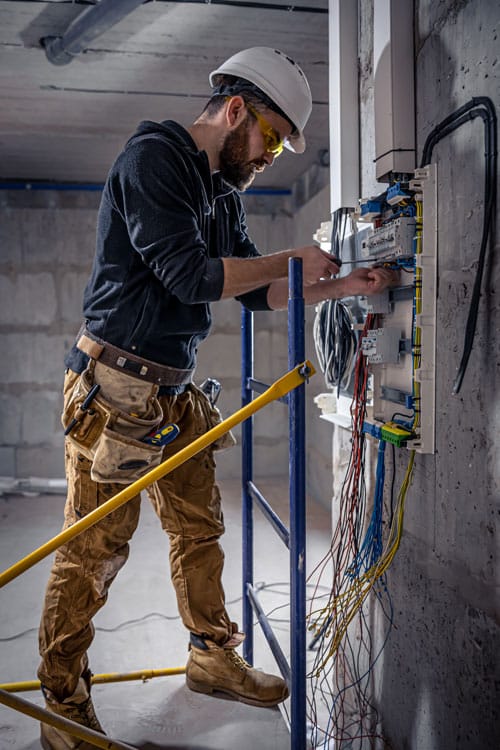
Electrical problems rarely announce themselves the way a burst pipe does. They show up as a breaker that trips a little too often, a switch plate that feels warm, lights that dim when the air conditioning starts. This guide explains what those signs mean, what modern protection actually does, and where the line sits between a homeowner task and work that needs a professional.
The Panel Is the Heart of the System
Everything electrical in your home passes through the service panel. Power arrives from the utility, runs through a main disconnect, and divides into the branch circuits feeding rooms and appliances. Each of those circuits has a breaker sized to protect the wire behind it.
That last point is worth dwelling on, because it is widely misunderstood. A breaker does not exist to protect your appliance. It exists to protect the wiring in your walls from carrying more current than it can safely handle. Conductors heat up under load, and a breaker is what stops that heating before it reaches the temperature at which surrounding materials ignite. Understood that way, a breaker doing its job is a safety device functioning correctly, not an inconvenience to be worked around.
When a Panel No Longer Suits How You Live
Many homes were wired for a household that owned considerably fewer electrical things than yours does. Electrical demand has grown steadily while the service feeding it has often stayed where it was.
Signs the service is stretched include lights dimming noticeably when a large appliance starts, reliance on power strips because there are too few outlets, a panel with no spare positions left, or a heavy dependence on extension leads as permanent wiring. Some older panels are also full of tandem breakers squeezed in to create capacity that was never really there.
Separately, certain panel makes and vintages have documented reliability concerns regarding breakers that may fail to trip when they should. If your panel is decades old, having someone identify what it is and assess its condition is a reasonable step — not because age alone is dangerous, but because you want to know whether the protection you are relying on is actually there.
A Breaker That Trips Repeatedly Is Telling You Something
An occasional trip after plugging in a heater on an already-loaded circuit is ordinary overload. Move something to another circuit and the matter is closed.
Repeated tripping is different, and the temptation is to reset and carry on. Resist it. Persistent tripping indicates sustained overload, a short circuit, a ground fault, or a breaker that has itself deteriorated. Each of those needs identifying rather than overriding.
What should never happen is replacing a breaker with a larger one to stop the nuisance. That does not solve anything — it removes the protection on wire that was already carrying more than it should, which is precisely the condition breakers exist to prevent. If a circuit genuinely needs more capacity, the wiring has to be sized for it, not just the breaker.
GFCI and AFCI Protect Against Different Things
These get confused constantly, and they are not interchangeable.
GFCI protection guards people against electric shock. It compares current flowing out against current returning, and if some is escaping by another path — through a person, for instance — it cuts power in a fraction of a second. This is why it belongs anywhere water and electricity coexist: kitchens, bathrooms, laundry areas, garages, and outdoors.
AFCI protection guards the building against fire. It detects the electrical signature of arcing — the sparking that occurs at a loose connection, a damaged cable, or a cord crushed behind furniture. Arcing generates significant heat without necessarily drawing enough current to trip a conventional breaker, which is exactly the gap this technology closes.
Both types should be tested periodically using their own test buttons. A device that does not trip when tested is not protecting anyone and needs replacing. General homeowner safety material is published by the Electrical Safety Foundation International.
Aluminium Branch Wiring in Older Homes
Homes wired during a stretch of the late 1960s and early 1970s sometimes have aluminium conductors on branch circuits. The concern is not the metal in itself but its behaviour at terminations: aluminium expands and contracts more than copper, and it oxidises differently, so connections can loosen over time. Loose connections are where arcing and heat originate.
If your home is of that era, this is worth identifying rather than assuming. Recognised remediation methods exist and are effective, but they are specific — this is not a case where swapping in ordinary devices is an adequate answer. It is also emphatically not homeowner work.
Warmth, Flicker, Discolouration, and Smell
These four signs share a cause worth knowing: resistance where there should be none, usually at a loose or degraded connection, converting electricity into heat.
- An outlet or switch plate that feels warm — not normal, whatever is plugged in.
- Scorching or brown discolouration around a socket — evidence that heating has already occurred.
- Flickering confined to one circuit, particularly if it worsens — distinct from the brief dip when a large motor starts.
- A burning or fishy plastic smell near a device — overheating insulation, and the most urgent of the four.
For a burning smell or visible scorching, switch that circuit off at the panel and leave it off until it has been examined. Continuing to use it is how a bad connection becomes a fire.
Why This Climate Matters Electrically
Two local factors deserve mention. The first is load duration: air conditioning running for long stretches through a long cooling season means circuits and connections spend far more hours under sustained load than in milder regions.
The second is ambient temperature. Equipment in a garage, an attic, or on an exterior wall lives in genuinely extreme conditions for months. Heat accelerates the degradation of insulation and terminations, and thermal cycling — hot afternoon, cooler night, repeated for years — works connections looser over time. Loose connections are the origin of most of the symptoms above.
EV Charging and Load Calculations
Adding a vehicle charger is not simply a matter of fitting an outlet in the garage. A charger represents a substantial, sustained load — often drawing near its rating for hours continuously, which is a very different demand profile from most household equipment.
The correct starting point is a load calculation: what your service capacity is, what the existing demand is, and what headroom remains. Sometimes the answer is straightforward. Sometimes the service needs upgrading first. Either way, that calculation is the step that determines whether the installation is safe, and skipping it is how people discover the limits of their panel the hard way.
Permits Exist to Protect You
Permits are often treated as bureaucracy, but the inspection is the point. It means someone independent of whoever did the work has verified it against code.
Panel changes, service upgrades, new circuits, and substantial rewiring generally require permitting. Unpermitted electrical work has a way of resurfacing at the worst moment — during a sale, during an inspection, or in an insurance claim following an incident. Requirements vary by jurisdiction, so confirm what applies locally before work begins rather than afterwards.
Where the Line Sits
Reasonable homeowner tasks: resetting a breaker once, testing GFCI and AFCI devices with their buttons, replacing light fixtures with power confirmed off at the breaker, changing lamps, and redistributing load away from overloaded circuits.
Not homeowner tasks, regardless of the tutorial: anything inside the panel, anything involving the service entrance or meter, new circuits, aluminium wiring remediation, and any diagnosis requiring the panel cover to come off. The service conductors entering a panel remain live even with the main breaker switched off, and that distinction is not obvious from the outside.
Questions From Henderson Homeowners
My lights dim briefly when the AC starts. Is something wrong?
A brief dip as a large motor starts is normal — starting current is much higher than running current. The concerns are a dip that is pronounced, one that lasts more than an instant, or one that has become noticeably worse than it used to be. Change over time is the signal.
Half my outlets stopped working but no breaker looks tripped.
Check GFCI devices first. One GFCI often protects several downstream outlets, so a single tripped device in a bathroom or garage can silence outlets in other rooms. Press reset on every GFCI you can find. Also note that a tripped breaker does not always look obviously different — switching it fully off and back on is the reliable test.
Are two-prong outlets a problem?
They indicate ungrounded wiring, which limits what can be safely connected and offers less protection for equipment and people. There are recognised approaches to addressing this. What is not acceptable is fitting a three-prong outlet onto ungrounded wiring, which creates the appearance of grounding without any of the protection.
Worth Having Looked At
Electrical faults give warning, and the warnings are quiet — the warm plate, the breaker tripping slightly more often than last year, the flicker you stopped noticing. Acting on those while they are still symptoms is straightforward. Acting after they become an event is not.
Hire The Hippo Ideal Services provides residential electrical service across Henderson and the Las Vegas Valley. If anything in your home is warm, scorched, or tripping repeatedly, contact our team and switch that circuit off in the meantime.
