 Skip to content
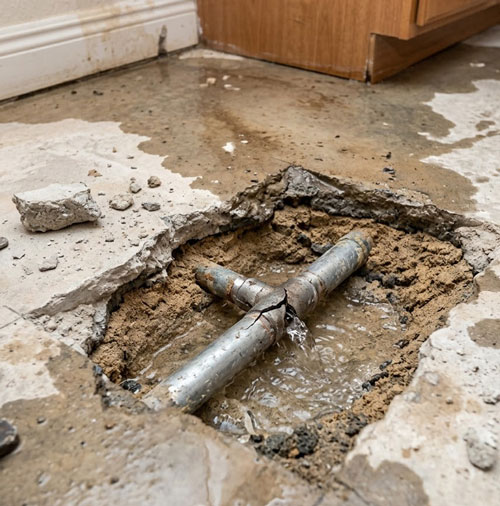
A slab leak is a pressurised water line failing underneath your foundation, where you cannot see it and it will not stop on its own. What makes them costly is rarely the pipe repair itself — it is the weeks or months of water running before anyone works out what is happening. This guide covers the signs, how leaks are located, and what the repair options actually involve.
What a Slab Leak Actually Is
Many homes here are built on a concrete slab poured directly on prepared ground, with water supply lines running beneath or within it. When one of those pressurised lines develops a fault, water escapes continuously — supply lines are under pressure around the clock, unlike a drain which only carries water when something is running.
That distinction matters. A dripping tap wastes water while it drips. A slab leak wastes water every hour of every day, and it does so into the ground beneath your foundation. This is why a comparatively small pipe fault can produce a startling bill and, given time, genuine structural concerns.
Why These Lines Fail Beneath Valley Homes
Several mechanisms act together, which is why slab leaks cluster in certain construction eras and neighbourhoods.
Corrosion from the inside. Copper develops pinhole corrosion over time, influenced by water chemistry and velocity. Mineral-rich supply is hard on plumbing generally, and the failure often appears as a tiny perforation rather than a burst.
Abrasion. Pipe that moves slightly against concrete or gravel every time it heats and cools will eventually wear through. Where a line was laid in direct contact with aggregate rather than properly sleeved, thousands of small expansions do the damage.
Ground movement. Soils that shift with moisture content place stress on rigid pipe and on joints, particularly at transitions and bends.
Why the Hot Line Usually Goes First
Hot water lines fail disproportionately often, and there are sound reasons. Heat accelerates the chemistry of corrosion. Hot lines expand and contract through a wider range with every draw, which drives the abrasion described above. Water velocity and temperature together are simply harder on copper than cold supply is.
This is also why the classic symptom is a warm patch on the floor. If a hot line is leaking beneath a slab, heat conducts up through the concrete and you can feel it — sometimes before any other sign appears.
The Signs, Roughly in Order of Reliability
- A warm or hot area on the floor with no other explanation — among the most specific indicators there is.
- The sound of running water with every fixture closed, often clearest at night.
- A water bill that rose without a change in habits and then stayed risen.
- Reduced pressure throughout the house, since water is escaping before it reaches fixtures.
- Damp carpet, warping flooring, or a musty smell in one area.
- New cracks in flooring or walls, which suggests the problem has been running long enough to affect the ground beneath.
Any one of these has innocent explanations. Two or three together rarely do.
The Meter Test You Can Run Yourself
Before calling anyone, you can establish whether water is moving when it should not be. It takes about half an hour and requires nothing but attention.
- Turn off every water-using fixture and appliance. Include icemakers, evaporative coolers, and irrigation — these are the ones people forget.
- Find the water meter and look at the low-flow indicator, usually a small triangular or star-shaped dial that turns on the slightest flow.
- If it is moving with everything off, water is escaping somewhere.
- Note the reading, wait an hour with no water used, and read it again to confirm.
This tells you there is a leak, not where it is. Irrigation faults and running toilets produce the same result, so the next step is isolating the house side from the irrigation side — which is where a professional locate begins. On water use generally, the EPA WaterSense program publishes useful reference material.
How Leaks Are Located Without Opening the Floor
This is the part that protects your budget. Concrete should be opened once, in the right place — the difference between a competent locate and guesswork is measured in square feet of floor.
Acoustic equipment amplifies the sound of pressurised water escaping through a small opening, which is distinctive and can be traced across a floor. Thermal imaging finds the temperature signature of a hot-line leak conducting up through the slab. Pressure isolation testing separates hot from cold and the house from the service line, narrowing which line is at fault before anyone listens for it. Tracer gas is available for leaks that resist the other methods.
A proper locate uses these in combination and marks a specific spot. Be wary of anyone proposing to open concrete based on where they think it probably is.
The Three Repair Approaches
Spot repair. Open the slab at the located point, repair that section, close it up. Least disruptive and least expensive where the pipe is otherwise sound and this is a first failure. The caveat is real: if the line failed because the pipe has reached the end of its service life, the next leak is elsewhere in the same run.
Reroute. Abandon the failed run and route a new line through walls or overhead instead of under the slab. More work initially, but it removes the section from beneath the foundation permanently and puts it somewhere accessible. Often the sensible choice on a second failure in the same line.
Repipe. Replace the supply system. Justified where the plumbing has a history of failures and the material has aged out generally. It is the largest job and, on the right house, the only one that stops the recurring calls.
Which is appropriate depends on pipe material, age, failure history, and how the house is laid out. Anyone recommending one before locating the leak is not giving advice. Fixture and material standards are maintained by bodies such as the IAPMO plumbing standards organisation.
What Waiting Actually Costs
Slab leaks do not improve. A pinhole enlarges as water passes through it, so the flow increases over time and so does the bill.
The compounding damage is the greater risk. Continuous water beneath a foundation can wash out supporting material and saturate soils that then move. Inside, sustained moisture affects flooring, subfloor, and finishes, and creates conditions for growth in materials that are difficult to dry. A repair deferred long enough stops being a plumbing job and becomes a restoration one.
Insurance: Read the Distinction Carefully
Homeowner policies commonly treat the failed pipe and the damage it caused as separate matters, and cover them differently. Terms vary considerably between insurers and policies, so the only reliable guidance is to read yours or ask your agent directly.
What helps in every case is documentation. Photograph what you observed, keep the locate report and the invoices, and record the dates. Claims are considerably easier to substantiate when the record was made as things happened rather than reconstructed afterwards.
Questions From Spring Valley Homeowners
Could this be irrigation rather than a slab leak?
Very possibly, and it is worth ruling out first because irrigation faults are far cheaper to fix. If your irrigation has its own shutoff, close it and repeat the meter test. Movement continuing with irrigation isolated points inside.
Will the floor have to come up?
Not necessarily. A reroute avoids opening the slab at all by taking the line a different way. Where a spot repair is chosen, the opening should be modest and specific — which is exactly what an accurate locate buys you.
Is it safe to keep using the water?
The water remains safe to use; the issue is the escaping volume and the damage accruing beneath. If the leak is substantial, knowing where your main shutoff is and how to operate it is worth five minutes of your time now rather than during an emergency.
Locate First, Then Open
The single most useful principle with slab leaks is that detection precedes demolition. Accurate location determines how much concrete comes up, how long the work takes, and what it costs. Everything else follows from that one step being done properly.
Hire The Hippo Ideal Services provides slab leak repair throughout Spring Valley and the wider valley, and our related drain and sewer specialists cover the waste side of the system. If your meter is turning with everything off, contact our team and ask for a locate before any concrete is opened.
